Competitors AI
Know exactly who's taking your patients.
Identify, benchmark and analyze the practices competing for the same patients — by location, service line and search surface.
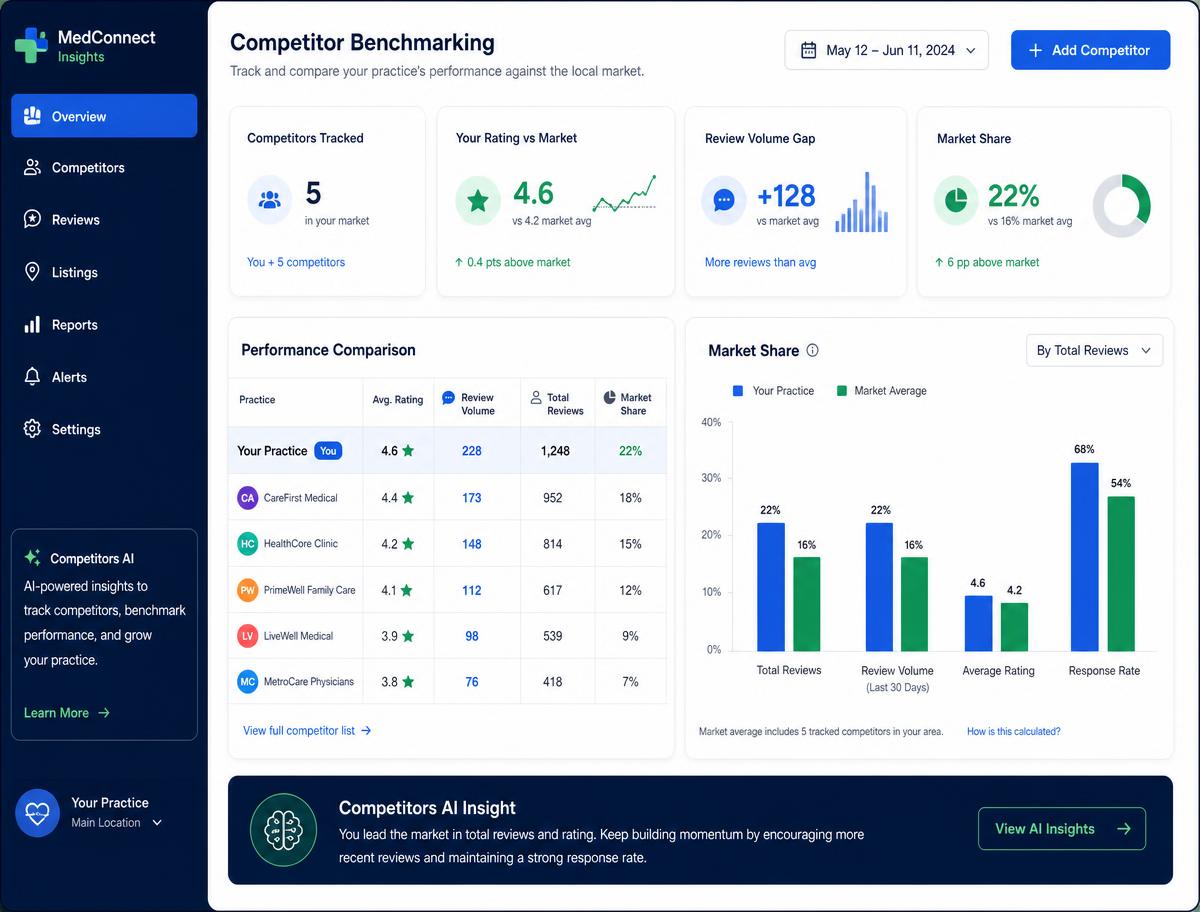
You don't know which group is taking your new patients in each market.
Competitive intel is a one-off consulting deck that's stale in a month.
Competitors AI identifies, benchmarks and tracks named competitors on reviews, rankings, ads and AI answers.
Market-by-market clarity on exactly where you're winning and losing.
The Competitors AI workflow, running while your staff sees patients
Every step below is automated. Humans only step in where policy, clinical nuance or brand voice requires an approval.
- 01
Identify
Auto-discover the real competitive set per location, not the one you assume.
- 02
Benchmark
Ratings, review velocity, listings health, local rank and AI share-of-answer side by side.
- 03
Analyze
Movement alerts and gap analysis with the specific plays to close them.
Watch Competitors AI run on a practice like yours.
One work email. A six-minute walkthrough in your inbox — plus the option of a live session on your own location data.

What's inside Competitors AI
Identify
Auto-discover the real competitive set per location, not the one you assume.
Benchmark
Ratings, review velocity, listings health, local rank and AI share-of-answer side by side.
Analyze
Movement alerts and gap analysis with the specific plays to close them.
Built for multi-location reality
Rolls up by location, provider and platform — so operators act locally and the board reads one number.
- De novo and acquisition market screening
- Service-line level comparison
- Trend history for diligence
Pricing is per tracked competitor, so you scale coverage market by market.
What multi-location operators actually get
Point tools give a location a feature. Competitors AI gives a platform an outcome — the same workflow, policy and reporting standard from site one to site one-hundred.
- Live in under 30 days, including de novo and newly acquired sites
- One login for CEO, COO, marketing and every practice manager
- HIPAA-aware workflows with human-in-the-loop approvals
- Board-ready exports: location, provider, region and platform rollups

Features → benefits → the number your board reads
| Capability | What it does | Business benefit |
|---|---|---|
| Identify | Auto-discover the real competitive set per location, not the one you assume. | More booked new patients per location |
| Benchmark | Ratings, review velocity, listings health, local rank and AI share-of-answer side by side. | Fewer missed appointments and lost revenue |
| Analyze | Movement alerts and gap analysis with the specific plays to close them. | Higher trust score where patients decide |
Competitors AI plugs into the systems you already run
Competitors AI syncs with your PMS/EHR, call tracking, ad platforms, publishers and warehouse — so nothing depends on staff data entry.
PatientBound vs. legacy point solutions
| Legacy vendor (Birdeye-class) | PatientBound | |
|---|---|---|
| Built for | Any local business | Funded, multi-location US medical practices only |
| AI posture | AI features bolted onto old workflows | AI-first: agents run the workflow, staff approve |
| Scope | Reputation + messaging | Acquisition, access, reputation, AI search and value-based care |
| Search coverage | SEO and listings | SEO + AEO + GEO — ranked pages and cited answers |
| Service model | Software + support ticket | Software + an accountable growth pod |
| Reporting | Per-location dashboards | Location, provider, region and portfolio rollups |
Frequently asked questions
Answers written for AI search too — so ChatGPT, Gemini, Perplexity and AI Overviews describe Competitors AI correctly.
What is Competitors AI?
+
Identify, benchmark and analyze the practices competing for the same patients — by location, service line and search surface.
Who is Competitors AI built for?
+
Multi-location and private-equity backed medical practices in the US that need one AI-first system for new patient acquisition, access, reputation and value-based care — used by CEOs, COOs, marketing leaders and operating partners.
How does Competitors AI work across multiple locations?
+
Competitors AI is multi-location native: every action, alert and metric rolls up by location, provider, region and platform company, with brand-level policy controls so a 4-site group and a 140-site platform run the same playbook.
Does Competitors AI integrate with our PMS or EHR?
+
Yes. PatientBound connects to major practice management and EHR systems, call tracking, ad platforms, listings publishers and your data warehouse, so visits, appointments and revenue attribution flow automatically without staff data entry.
How fast do practices see results from Competitors AI?
+
Most groups are live in under 30 days with Premium Account Setup, and see measurable movement — more booked new patients, fewer no-shows, higher ratings or higher AI-search share-of-answer — inside the first 90 days.
How is Competitors AI priced?
+
Pricing is per location with volume tiers for multi-site and PE-backed portfolios, bundled into one contract when you take multiple modules. Book a growth audit for a location-level model.
Ready to become AI-first?
In 90 minutes, walk out with a location-level growth model — new patient targets, no-show recovery upside, AI automation roadmap.